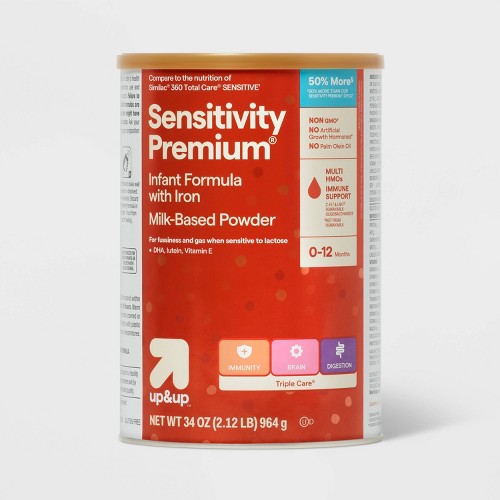
Up&Up
Sensitivity Premium
Powdered infant formula. Lab results are from the March 2026 Consumer Reports sample.
Product and label references (not tied to the lab sample): Product and package information · FDA U.S. marketed-formula listing
Ingredients
- corn syrup, milk protein isolate, high oleic (safflower or sunflower) oil, sucrose, soy oil, coconut oil, less than 2%: mortierella alpina oil, schizochytrium sp. oil, 2'-fucosyllactose (2'-fl), lacto-n-neotetraose (lnnt), lutein, calcium phosphate, potassium citrate, potassium chloride, sodium citrate, magnesium phosphate, ascorbic acid, calcium carbonate, ferrous sulfate, magnesium chloride, ascorbyl palmitate, choline bitartrate, taurine, inositol, vitamin e (dl-alpha tocopheryl acetate), zinc sulfate, mixed tocopherol concentrate, l-carnitine, niacin (niacinamide), calcium pantothenate, vitamin a palmitate, cupric sulfate, thiamine hydrochloride, riboflavin, pyridoxine hydrochloride, beta-carotene, folic acid, manganese sulfate, potassium iodide, vitamin k (phytonadione), biotin, sodium selenite, vitamin d (cholecalciferol), cyanocobalamin, potassium hydroxide, potassium bicarbonate, sodium chloride, sodium phosphate, monoglycerides, soy lecithin, nucleotides (adenosine-5'-monophosphate, cytidine-5'-monophosphate, disodium guanosine-5'-monophosphate, disodium uridine-5'-monophosphate)
Screening estimate
Higher estimated intake vs anchors for at least one metal.
Lab report
Detected heavy metals
Consumer Reports independent testing, March 2026 · powder concentration · article · results PDF · Not affiliated with Consumer Reports
This screening estimate uses the powder sample tested in March 2026. The report does not identify the lot; it does not establish what is in other batches. See all 11 reported lab results.
See the breakdown below for non-detects and metals with no result. Results describe the tested sample and format. Other lots can differ. How to read these numbers · Report a data issue
About the score — screening estimate. Scores are a screening estimate, not a final rating or a safety verdict. They compare estimated intake over about a year of feeding with named protective reference levels, and the method is still being reviewed. Untested metals are never counted as clean; a metal the lab tested and did not detect adds zero scoring penalty. A non-detect does not establish zero concentration. Method explained on Learn.
~1-year intake listing
Estimated intake vs protective anchors
Add a child label to personalize this estimate.
Default: 24 fl oz/day × 365 days (example scenario, not a feeding recommendation). (~105.6 g powder/day at 4.4 g/fl oz). We don't have a current price for Sensitivity Premium, so cost isn't estimated.
A non-detect means the lab did not detect that metal using its test. It adds 0 scoring penalty, but does not establish a concentration of zero.
Anchors are protective references (e.g. CA OEHHA Pb MADL 0.5 µg/day; Cd MADL 4.1 µg/day; EPA iAs RfD with disclosed 6.1 kg infant; Al FAO/WHO 400 ppb powder MPL as screening context) — not “safe/unsafe” diagnoses and not EU legal MLs. Assumptions are editable above. See Learn. Discuss with your pediatrician.
Price and product information
Price not listed
Retail price and container size are not in this catalog.
No verified retailer link for this exact formula is listed.
Compare


